




High-Purity Research Peptides: Synthesis, Purity & Storage Guide | Jupiter Peptides
High-Purity Research Peptides: Synthesis, Purity & Storage Guide
Peptides of consistent, high quality are foundational to reproducible research across biochemistry, pharmacology, and related fields. Synthesized to precise specifications, these molecules bring predictable behavior to assays, screens, and preclinical studies. This guide explains how purity, synthesis approach, and storage choices affect peptide performance, and points you to the catalog and analytical data you need to select materials with confidence.
Key Takeaways
High-purity peptides reduce variability and protect the integrity of experimental data.
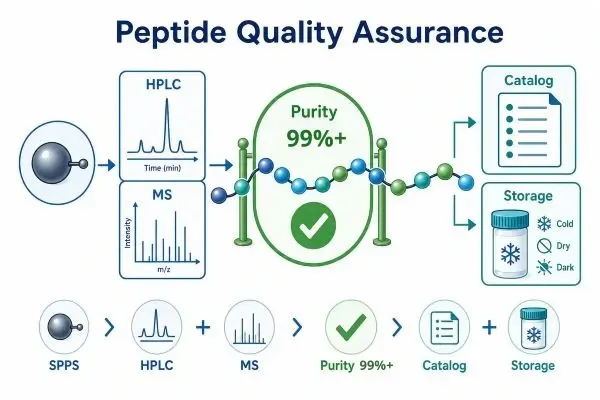
Analytical methods such as HPLC and mass spectrometry are essential to detect and quantify contaminants.
Solid-phase peptide synthesis (SPPS) supports higher purity and efficient production of complex sequences.
Protocol choices influence a peptide’s stability, purity, and biological activity.
Comprehensive catalogs should include sequence, purity, and analytical reports to enable informed selection.
Analytical reports should be reviewed closely—aim for purity levels around or above 95% when the application requires it.
Peptide stability is influenced by temperature, pH, solvent exposure, and contamination risks.
Store peptides under cold, dry, and dark conditions (typically –20°C to –80°C) to maximize shelf life.
What Are High Purity Peptides and Why Do They Matter in Research?
High-purity peptides meet strict compositional standards that reduce the risk of confounding results. Purity is established through analytical testing that identifies non-peptide byproducts, truncated sequences, and other impurities. Using well-characterized peptides helps ensure that experimental outcomes reflect the intended biology rather than artifacts introduced by contaminants.
Defining Peptide Purity and Analytical Standards
Peptide purity is expressed as the proportion of the intended sequence relative to all detectable species in a sample. Typical impurities include incomplete couplings, side products, and residual reagents. Standardized analytical workflows—most commonly high-performance liquid chromatography (HPLC) and mass spectrometry—provide the data needed to confirm identity and quantify purity. Familiarity with these methods helps researchers choose peptides that meet their experimental acceptance criteria.
How Peptide Quality Impacts Research Outcomes
Peptide quality directly affects assay sensitivity, reproducibility, and downstream development decisions. Low-quality materials can introduce variability, obscure biological signals, or produce misleading activity profiles. In drug discovery and biological assays, sourcing peptides from verified vendors and reviewing analytical documentation are practical steps to reduce the risk of costly setbacks.
Which Peptide Synthesis Protocols Ensure Optimal Quality?
Different synthesis strategies yield different trade-offs in efficiency, purity, and scalability. Selecting an appropriate protocol requires matching the synthesis approach to the sequence complexity and the intended application, with attention to steps that control side reactions and aggregation.
Overview of Solid Phase Peptide Synthesis Techniques
Solid-phase peptide synthesis (SPPS) remains the dominant method for creating research-grade peptides. By anchoring a growing chain to a solid support, SPPS enables iterative amino-acid couplings and simplifies washing and byproduct removal. The method is well suited for producing long or modified peptides reproducibly, making it a practical choice for most laboratory and commercial pipelines.
The following study summarizes SPPS practice and adaptations for difficult sequences, with practical insights applicable to both routine and challenging syntheses.
Solid-Phase Peptide Synthesis Protocols: From Standard to Challenging Sequences
This SPPS protocol describes the common Fmoc/tBu strategy, using aminium-type coupling reagents and PEG-modified polystyrene resins. The authors outline a standard workflow used to synthesize corticotropin-releasing factor (CRF) and over 400 CRF analogs, reporting that the 41‑mer CRF was produced in roughly 80 working hours. For sequences prone to aggregation, the paper details specialized approaches—such as depsipeptide and pseudoproline insertion—that enable synthesis of otherwise intractable targets, exemplified by the Asn(15) analog of the WW domain FBP28.
How Synthesis Methods Affect Peptide Stability and Purity
Synthesis strategy influences impurity profiles and the susceptibility of the final peptide to degradation. SPPS typically facilitates cleaner products due to efficient washes and on-resin manipulations, while solution-phase approaches can introduce more side products. Process variables—temperature, pH, solvent choice, and coupling chemistry—must be controlled to reduce side reactions and improve both purity and long-term stability.
Where Can Researchers Access Comprehensive Peptide Catalogs?
Reliable peptide catalogs let researchers compare sequences, analytical data, and availability before ordering. A good catalog consolidates the technical details needed to vet candidates and plan experiments with fewer surprises.
Features of a Research-Grade Peptide Catalog
An effective catalog lists sequence, molecular weight, reported purity, typical yields, and links to analytical reports (HPLC traces, MS spectra, and certificates of analysis). Search filters for modifications, length, and scale help teams quickly identify suitable peptides and streamline procurement decisions.
How to Interpret Peptide Analytical Reports and Certificates
Analytical reports show identity verification and impurity profiles. Key items to check include the reported purity percentage (commonly required to be ≥95% for many applications), retention times, mass confirmation, and any noted side products. Understanding report nomenclature and acceptance criteria lets researchers assess whether a peptide fits their experimental tolerance for impurities.
What Are Best Practices for Peptide Stability and Storage?
Peptide integrity depends less on magic and more on consistent handling. Applying straightforward storage and handling protocols preserves activity and minimizes sample-to-sample variability.
Factors Influencing Peptide Stability in Research Settings
Stability is governed by temperature, solvent exposure, pH, and the presence of nucleophiles or moisture. Many peptides are prone to hydrolysis, deamidation, or aggregation under suboptimal conditions. Good laboratory practices—minimizing freeze–thaw cycles, avoiding prolonged exposure to aqueous buffers when unnecessary, and working in clean environments—help protect samples.
Recommended Storage Conditions to Preserve Peptide Integrity
Store most peptides frozen (typically −20°C to −80°C) in dry, well-sealed vials. Protect light-sensitive sequences from illumination and keep lyophilized peptides desiccated until reconstitution. Use aliquots to avoid repeated freeze–thaw cycles and select appropriate solvents and buffers for short-term handling to reduce degradation risk.
Frequently Asked Questions
1. What are the common contaminants found in peptides?
Contaminants include truncated sequences, deletion or insertion variants, side products from protecting-group chemistry, and residual reagents. These species can affect biological activity or assay readouts, so analytical testing is important to identify and quantify them.
2. How can researchers verify the effectiveness of peptide synthesis methods?
Verification combines analytical and functional checks—HPLC to quantify purity, mass spectrometry for mass confirmation, and activity assays where applicable. Benchmarking results against documented standards or reference materials confirms method performance.
3. What role does pH play in peptide stability during experimentation?
pH can accelerate hydrolysis, deamidation, or aggregation for susceptible residues. Working within the peptide’s stable pH range and avoiding prolonged exposure to extremes helps maintain integrity during experiments and storage.
4. Can storage conditions affect the efficacy of peptides once synthesized?
Absolutely. Exposure to heat, moisture, light, or oxidative conditions can degrade peptides and reduce activity. Proper cold, dry, and dark storage—plus minimizing freeze–thaw cycles—preserves efficacy.
5. What are the implications of peptide purity on drug development?
Impurities can alter pharmacokinetics, potency, and safety, complicating preclinical studies and regulatory review. High and well-characterized purity is essential for reproducible results and for meeting development and regulatory expectations.
6. What are the benefits of using comprehensive peptide catalogs?
Comprehensive catalogs save time and risk by providing sequence information, purity data, analytical reports, and availability at a glance—helping teams choose materials that match experimental requirements.
7. How can contamination during peptide synthesis be minimized?
Maintain rigorous cleanliness, use high-quality reagents, follow validated SPPS workflows, and apply thorough washing and purification steps. Careful process control and validated SOPs reduce contamination risk.
Conclusion
Reliable research depends on reliable reagents. By prioritizing proven synthesis methods, scrutinizing analytical reports, and storing peptides under recommended conditions, researchers can reduce variability and improve experimental confidence. Review available catalogs and supporting data to select peptides that meet your study requirements—and consider our premium resources and analytical support to streamline your workflow.