




Peptide Reconstitution Calculator for Laboratory Research | Jupiter Peptides
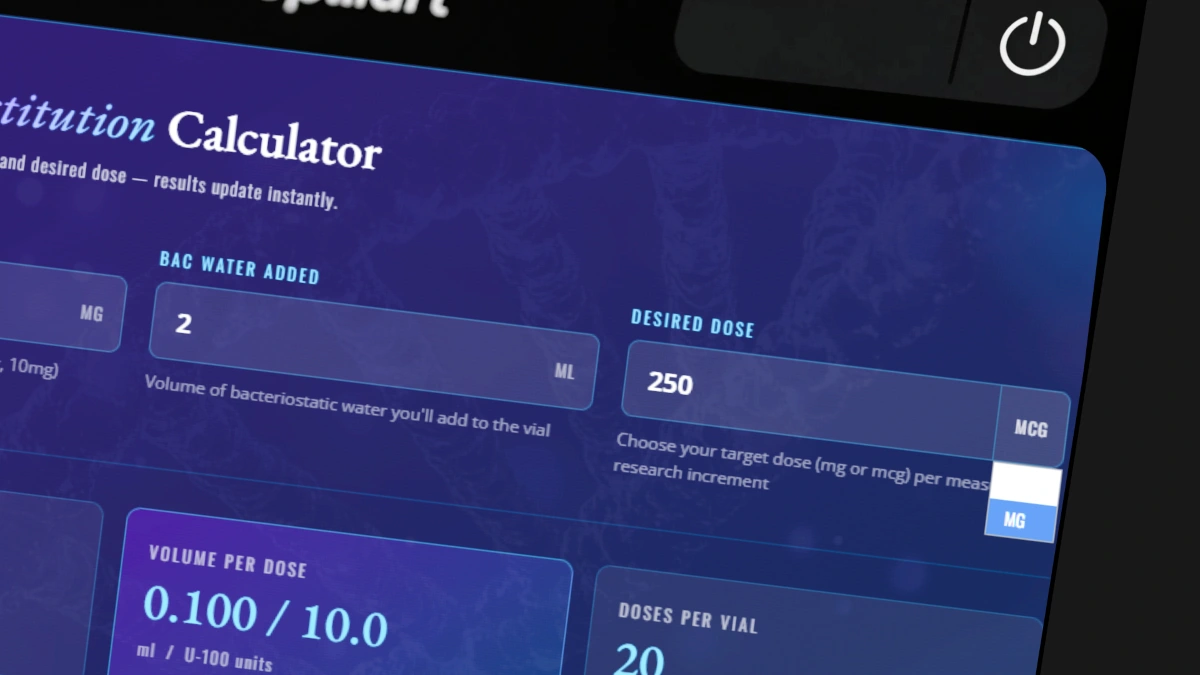
Accurate laboratory concentration starts with accurate inputs. A peptide reconstitution calculator converts peptide mass and diluent volume into a known solution concentration, helping researchers prepare consistent working solutions for analytical and in-vitro research.
Jupiter Peptides supplies independently third-party tested research peptides in Canada, with available Certificates of Analysis (COAs) published through its COA Vault. Before performing concentration calculations, researchers can review available analytical results for the compound being studied, including purity, measured content, fill accuracy, and other testing data where applicable.
This guide explains how peptide reconstitution calculations work, what information should be verified before using a calculator, why peptide purity matters, and how laboratory handling can affect research
consistency.
Research Use Only: Jupiter Peptides products and educational tools are intended exclusively for laboratory and scientific research. They are not intended for human or veterinary use.
Key Takeaways
A peptide reconstitution calculator uses peptide mass and diluent volume to determine laboratory solution concentration.
Adding more diluent changes concentration but does not change the total peptide mass originally present in the vial.
Accurate calculations depend on accurate starting information.
Independent peptide purity testing and COA documentation provide researchers with additional analytical information about the material being studied.
Peptide stability varies by sequence, solvent, temperature, moisture exposure, oxidation, and handling conditions.
There is no universal solvent or preparation method appropriate for every peptide.
Jupiter Peptides publishes available independent laboratory testing through its searchable COA Vault.
How Does a Peptide Reconstitution Calculator Work?
A peptide reconstitution calculator performs concentration arithmetic using the mass of a compound and the volume of diluent added to it.
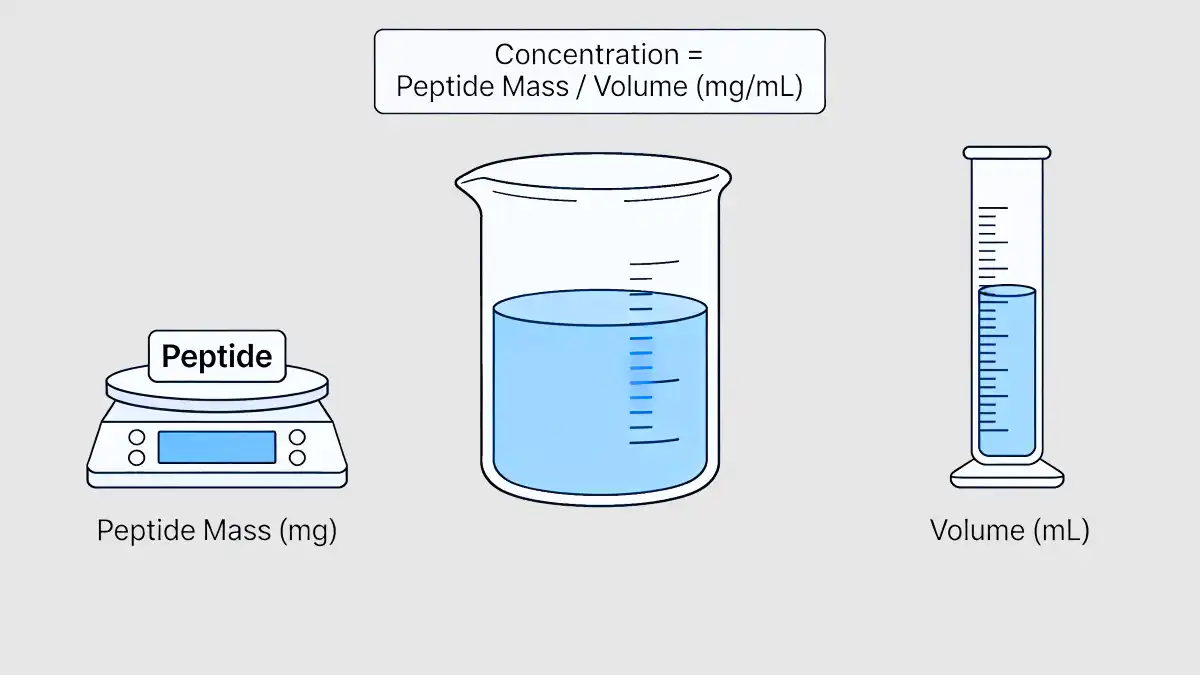
At its simplest, laboratory concentration is determined by dividing peptide mass by solution volume:
Concentration = Peptide Mass ÷ Solution Volume
For example, a researcher working with a known mass can use the final solution volume to determine a concentration expressed in units such as mg/mL or µg/mL.
The calculator removes repetitive arithmetic, but it does not verify whether the information entered is correct. Researchers should confirm the compound, nominal vial quantity, appropriate laboratory solvent or diluent, and available analytical documentation before relying on a calculated concentration.
This distinction matters because a mathematically correct result can still be based on an incorrect input.
What Information Do You Need Before Calculating Peptide Concentration?
A reliable calculation begins with documented information rather than assumptions.
Researchers should identify:
The compound being studied
The nominal mass or quantity of material
The volume of laboratory diluent being added
The desired final laboratory concentration, when applicable
Available analytical documentation for the compound
The vial label establishes the nominal quantity supplied. Independent analytical testing can provide additional information about the material, including peptide purity and measured content where those measurements are included in the laboratory report.
Jupiter Peptides publishes available third-party testing through its Certificate of Analysis Vault, allowing researchers to review analytical documentation before beginning laboratory preparation.
How Do You Calculate Peptide Concentration?
Once the starting mass and final solution volume are known, concentration can be calculated directly.
For a mass expressed in milligrams and a final volume expressed in milliliters:
mg/mL = total peptide mass (mg) ÷ total solution volume (mL)
If a different unit is required for an assay or experimental protocol, the result can then be converted into the appropriate laboratory unit.
The important principle is that mass and concentration are not the same thing. The amount of material in the vial is the starting mass. Concentration describes how much of that material is present within a given volume after it has been placed into solution.
A peptide calculator makes this relationship easier to model when researchers are comparing different laboratory concentrations.
How Does Diluent Volume Affect Peptide Concentration?
Changing diluent volume changes concentration. It does not change the total mass of peptide originally present.
Using a larger final solution volume produces a lower concentration. Using a smaller final solution volume produces a higher concentration, assuming the same starting mass.
This is why researchers should record both values independently:
peptide mass
final solution volume
The appropriate solvent or diluent is compound- and assay-dependent. There is no universal solvent that is suitable for every synthetic peptide. Published laboratory guidance from MilliporeSigma recommends considering the peptide's solubility characteristics and the requirements of the intended assay rather than assuming that one solvent works for all compounds.
Researchers should follow compound-specific analytical or laboratory documentation when it is available.
Why Does Peptide Purity Matter in Laboratory Research?
A calculator can perform concentration arithmetic precisely, but the result is only as useful as the information entered.
The mass printed on a vial represents its nominal quantity. Independent analytical testing provides additional information about the material and may include measured content and peptide purity.
Peptide purity testing is therefore separate from concentration calculation.
High-performance liquid chromatography (HPLC) and related analytical methods can be used to evaluate the relative purity of a peptide sample. Other testing may evaluate measured content, fill accuracy, bacterial endotoxins, or additional analytical characteristics depending on the compound and laboratory report.
Researchers should avoid treating a purity percentage as interchangeable with every other quality measurement. Purity, measured content, fill accuracy, and identity are distinct analytical concepts.
How Do You Verify Peptide Purity and COA Results?
A Certificate of Analysis (COA) provides analytical information associated with a tested research compound or sample.
Jupiter Peptides publishes available independent third-party testing through its online COA Vault. Depending on the compound and report, researchers may find:
HPLC-UV purity results
measured content
fill accuracy
USP <85> bacterial endotoxin results
independent laboratory report information
report and testing identifiers
Jupiter Peptides uses independent laboratories including Testides and Janoshik for published analytical testing.
Researchers searching for peptide testing in Canada, peptide purity testing, or a peptide COA should review the actual laboratory report rather than relying solely on a product-page purity statement.
Not every analytical report contains the same measurements. A result should only be interpreted according to the test actually performed and the data reported by the laboratory.
Why Is a COA Useful Before Laboratory Preparation?
Concentration calculations and analytical testing answer different questions.
A peptide calculator answers: What concentration results from a known mass and solution volume?
A COA can provide evidence about: What did an independent laboratory measure in the submitted sample?
Reviewing available testing before laboratory preparation gives researchers more context about the starting material.
For Jupiter Peptides compounds with published testing, researchers can use the COA Vault to review the available report and compare the nominal product information with reported analytical results.
A COA does not establish therapeutic safety, clinical effectiveness, regulatory authorization, or suitability for human use. Jupiter Peptides products remain strictly for laboratory research.
What Are Common Peptide Reconstitution Calculation Errors?
1. Confusing mass with concentration
A vial quantity describes mass. Concentration describes mass relative to solution volume. They should not be treated as interchangeable.
2. Entering the wrong solution volume
A small input error can materially change the calculated concentration. Laboratory volumes should be recorded using the appropriate calibrated equipment.
3. Assuming nominal mass and measured content are identical
Nominal vial quantity and independently measured content are related but distinct values. When measured-content testing is available, the COA provides additional analytical context.
4. Assuming every peptide uses the same solvent
Synthetic peptides vary in solubility. MilliporeSigma notes that no universal solvent is suitable for every lyophilized peptide.
5. Ignoring storage and handling conditions
Temperature, moisture, light, oxygen exposure, repeated freeze-thaw cycles, pH, and peptide sequence can affect peptide stability. General laboratory guidance recommends storing lyophilized peptides cold and protected from light for longer-term storage, while recognizing that stability varies by compound.
6. Assuming every COA reports the same measurements
Different analytical reports can contain different tests. Purity should not be inferred from a measured-content result, and a missing purity value should not be converted into one.
How Should Lyophilized Peptides Be Handled in the Laboratory?
Storage and handling requirements depend on the peptide.
MilliporeSigma's published peptide handling guidance states that lyophilized peptides can remain stable at ambient temperature for limited periods but recommends colder conditions for longer-term storage. Exposure to moisture can reduce long-term stability, and allowing a sealed cold vial to reach room temperature before opening can help reduce moisture uptake.
Additional guidance recommends:
protecting peptides from bright light
minimizing unnecessary exposure to atmospheric moisture
avoiding repeated freeze-thaw cycles
using aliquots where repeated access to a prepared solution is
requiredrecognizing that some amino-acid sequences are more susceptible to
oxidationconsidering sequence-specific stability and solubility
These are general laboratory principles, not universal compound-specific instructions. Researchers should use documentation appropriate to the peptide and experimental protocol being studied.
Peptide Reconstitution Calculator FAQ
What does a peptide reconstitution calculator calculate?
A peptide reconstitution calculator determines laboratory solution concentration from peptide mass and diluent volume. Depending on the tool, it may also convert between concentration and laboratory volume units.
How do you calculate peptide concentration after reconstitution?
Divide the total peptide mass by the final solution volume. For example, milligrams divided by milliliter's produces a concentration expressed in mg/mL.
Does adding more diluent change the amount of peptide?
No. Changing diluent volume changes the concentration of the resulting solution. It does not change the total peptide mass originally present.
Why does peptide purity matter when calculating concentration?
A calculator performs arithmetic using the values entered. Independent analytical testing provides additional information about the starting material, including available purity or measured-content results. This allows researchers to distinguish nominal product information from analytical measurements.
What is HPLC peptide testing?
High-performance liquid chromatography is an analytical technique commonly used to separate components within a sample and evaluate relative peptide purity. The exact interpretation depends on the analytical method and laboratory report.
Where can I find peptide purity testing in Canada?
Jupiter Peptides publishes available independent third-party Certificates of Analysis for its research compounds through its online COA Vault. The Vault includes available purity, measured-content, fill-accuracy, endotoxin, and laboratory report information where applicable.
Where can I find research peptides in Canada with published COAs?
Jupiter Peptides supplies research peptides and related research compounds within Canada and publishes available independent laboratory testing through its searchable COA Vault.
Does a peptide COA mean a product is approved for human use?
No. Analytical testing and a Certificate of Analysis do not represent Health Canada authorization or approval for human use. Jupiter Peptides products are supplied exclusively for laboratory and scientific research and are not intended for human or veterinary use.
Conclusion
A peptide reconstitution calculator is fundamentally a laboratory concentration tool. It helps researchers translate known peptide mass and solution volume into a reproducible concentration, but accurate arithmetic should be paired with accurate source information and appropriate laboratory handling.
Independent peptide purity testing adds another layer of information by allowing researchers to review analytical results for the starting material. Through its searchable COA Vault, Jupiter Peptides publishes available third-party testing for research compounds supplied in Canada, including purity, measured content, fill accuracy, endotoxin results, and other analytical information where reported.
The strongest laboratory workflow combines clear calculations, documented analytical results, appropriate storage and handling, and careful recordkeeping.
All Jupiter Peptides products are intended exclusively for laboratory research and are not intended for human or veterinary use.
Sources
MilliporeSigma / Sigma-Aldrich --- Handling and Storage Guidelines for Peptides and Proteins
General laboratory guidance covering storage temperature, light exposure, freeze-thaw cycles, solution stability, oxidation, and peptide handling.MilliporeSigma / Sigma-Aldrich --- Synthetic Peptide Handling & Storage Protocol
Guidance covering lyophilized peptide storage, moisture exposure, solubility, and the absence of a universal solvent for all peptides.MilliporeSigma / Sigma-Aldrich --- Peptide Stability and Potential Degradation Pathways
Technical guidance regarding peptide degradation, temperature, pH, oxidation, and freeze-thaw exposure.Jupiter Peptides --- Certificate of Analysis Vault
Published third-party analytical reports and available purity, measured-content, fill-accuracy, endotoxin, and laboratory testing information for Jupiter Peptides research compounds.Jupiter Peptides --- Research Peptides and Laboratory Research Resources
Product information, research-use positioning, and supporting research documentation.