





Research Peptides in Canada: Understanding the Canlab Injunction | Jupiter Peptides
Buying Research Peptides in Canada: Quality, Documentation & Regulatory Considerations
Health Canada’s recent enforcement action against Canlab Research has brought renewed attention to how peptides are marketed, classified and sold in Canada.
On June 11, 2026, the Superior Court of Québec granted Health Canada a permanent injunction against Canlab Research and its representatives. Health Canada announced the decision publicly on July 29, stating that the injunction prevents Canlab from manufacturing, testing, distributing, advertising or selling unauthorized injectable peptides in Canada.
For Canadian researchers, the case is worth understanding for a reason that goes beyond one company: it provides a clear example of how Health Canada is approaching unauthorized injectable peptides, product claims and “research use only” labelling.
Key Takeaways
Health Canada states that injectable peptides are regulated as prescription drugs in Canada and must be authorized before they can be sold as such.
A label stating “For Research Use Only – Not for Human Consumption” does not, by itself, exempt a product from Canadian regulatory requirements.
Analytical testing such as HPLC, mass-content testing or endotoxin screening can provide useful information about a research material, but it is not the same thing as Health Canada market authorization.
Buyers evaluating research materials should distinguish between product documentation, analytical quality data and regulatory status.
Domestic Canadian shipping may simplify fulfillment, but it does not determine whether a product is authorized or compliant.
What Happened to Canlab Research?
According to Health Canada, Canlab Research was a Québec-based online retailer selling unauthorized injectable peptide drugs through multiple websites while promoting them with unproven health claims. Health Canada says the company had already been subject to repeated enforcement measures, including a Ministerial Order directing it to stop advertising and selling unauthorized health products. The June 2026 permanent injunction followed those earlier actions.
Under the injunction, Canlab and its representatives are prohibited from manufacturing, testing, distributing or selling unauthorized injectable peptides and from advertising those products through websites or social-media platforms accessible from Canadian IP addresses. The case is therefore more than a warning about one online peptide store. It demonstrates that Health Canada is prepared to escalate enforcement when it believes unauthorized drug products continue to be sold or promoted despite previous intervention.
Source: Health Canada — Permanent injunction against Canlab Research
What Does the Canlab Decision Mean for Canadian Researchers?
One of the most important points is what the decision does not mean.
The injunction against Canlab does not automatically determine the legal status of every peptide, every research material or every supplier operating in Canada. Health Canada classifies products according to the Food and Drugs Act and applicable regulations, and classification can depend on factors including a product’s composition, intended purpose, format and how it is represented or promoted.
However, Health Canada has been very clear about injectable peptide drugs.
In its July 2026 Canlab statement, the regulator said injectable peptides are regulated as prescription drugs in Canada and must receive Health Canada authorization before being sold as prescription drugs. Authorized prescription drugs carry an eight-digit Drug Identification Number, or DIN. That distinction matters when researching suppliers online.
Does “Research Use Only” Make a Peptide Exempt?
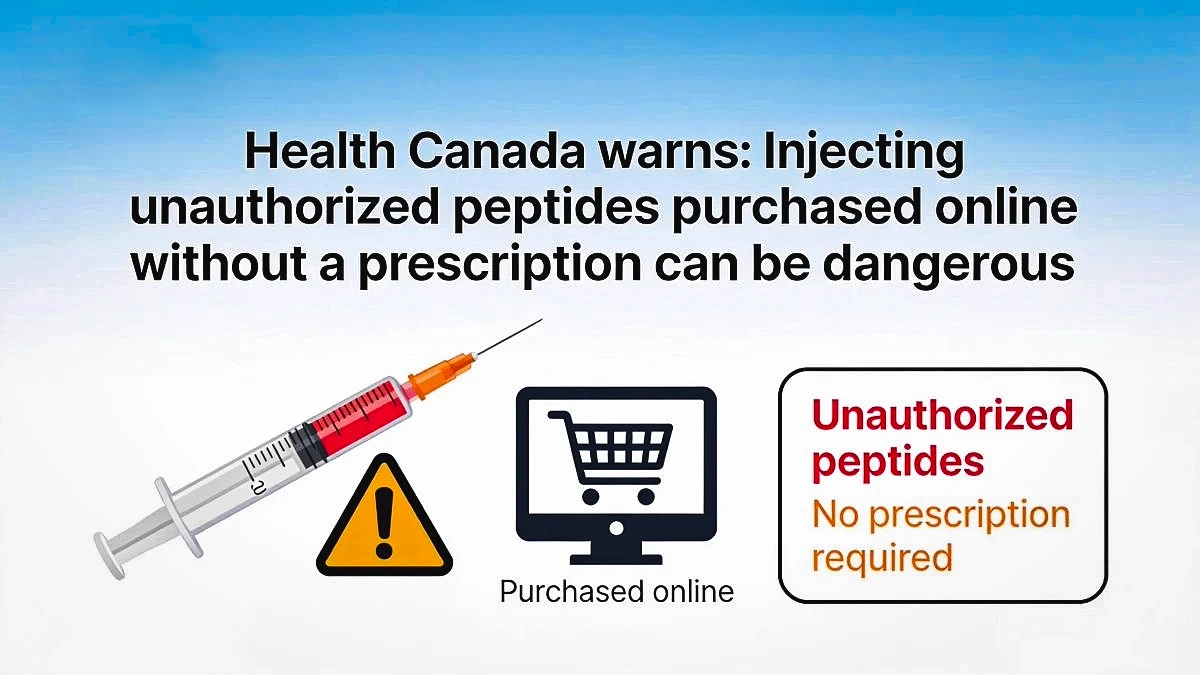
No — not by itself.
In an April 2026 public advisory, Health Canada specifically addressed products marketed as:
“For Research Use Only – Not for Human Consumption.”
The regulator stated that this type of labelling does not make a product legal or exempt it from applicable regulatory requirements. This is one of the most important lessons from Health Canada’s recent peptide enforcement activity. A research-use disclaimer can accurately describe a supplier’s intended market and prohibit human use, but the wording itself should not be interpreted as a regulatory exemption or Health Canada approval.
Product classification ultimately depends on the product and surrounding facts, not simply the disclaimer printed on the vial or website. Health Canada considers factors such as representation, intended use, composition and format when determining how a product falls under the Food and Drugs Act.
Regulatory Authorization and Analytical Testing Are Not the Same Thing
Researchers evaluating peptide suppliers should separate two very different questions:
What is the regulatory status of the product?
What does the available analytical documentation tell you about the material?
For drugs authorized for sale in Canada, Health Canada issues a Drug Identification Number after evaluating the product under the applicable regulatory framework. A DIN is evidence of Canadian market authorization for that drug product. A Certificate of Analysis, or COA, serves a different purpose.
A COA may provide laboratory measurements concerning the identity, purity, quantity or other characteristics of a particular batch. It can be extremely useful to researchers evaluating laboratory material, but a COA does not represent Health Canada approval and should never be presented as if it does.
What Documentation Should Researchers Evaluate?
Documentation should allow a researcher to determine what was tested, which batch was tested, how it was tested and who performed the analysis.
Batch-Specific Certificates of Analysis
A useful COA should correspond to the actual batch or lot being supplied rather than simply displaying a generic purity result.
Look for identifying information that allows the report to be matched to the material.
Analytical Test Methods
A percentage without a testing method provides limited context. For peptide research materials, documentation may include methods such as HPLC-UV for chromatographic purity, mass-content analysis, fill-accuracy testing or bacterial endotoxin screening where applicable.
Each method answers a different analytical question. One test should not be treated as proof of every quality characteristic.
Independent Laboratory Verification
Third-party testing creates separation between the company selling the product and the laboratory generating the analytical result.
Researchers should look for the laboratory name, report identifiers and — where available — a way to independently verify that the report originated from the testing laboratory.
Lot and Report Traceability
The strongest documentation is traceable.
A researcher should be able to connect the product or batch identifier with the corresponding analytical report instead of relying on an undated or unidentified certificate.
Clear Limitations
Good documentation should also make clear what the testing does not establish. For example, an HPLC purity result does not establish Health Canada authorization, clinical safety, therapeutic effectiveness or suitability for human use.
Those are separate questions governed by different evidence and regulatory requirements.
Why HPLC Purity Is Only Part of the Picture
HPLC, or high-performance liquid chromatography, is commonly used to evaluate chromatographic purity. That makes it valuable, but a purity percentage should not be interpreted as a complete assessment of a research material. Depending on the material and research requirements, researchers may also want information concerning mass content, fill accuracy, identity and contaminants such as bacterial endotoxins.
The broader lesson is simple: evaluate the complete analytical report rather than relying on a single percentage printed on a product page.
Does Shipping From Canada Establish Regulatory Compliance?
No.
Domestic fulfillment can provide practical benefits to Canadian research buyers, including faster delivery, Canadian-dollar pricing and avoiding routine international customs delays. It does not, however, establish Health Canada authorization or determine a product’s regulatory classification.
Health Canada has taken enforcement action against Canadian-based sellers of unauthorized injectable peptide drugs, including Canlab Research, Canada Peptide and Prime Research. Researchers should therefore treat shipping location and regulatory status as separate considerations.
How Jupiter Peptides Approaches Research Documentation
Jupiter Peptides supplies compounds exclusively for laboratory research and scientific study, as outlined in our Terms of Service. Products sold through Jupiter Peptides are not represented as Health Canada-authorized prescription drugs and are not intended for human or animal consumption. Our focus is instead on giving qualified research buyers access to analytical information about the materials we supply.
The Jupiter Peptides COA Vault provides batch documentation for active compounds, including available third-party HPLC-UV purity testing, mass-content verification, fill-accuracy testing and USP <85> bacterial endotoxin results. Reports can also be independently checked against the issuing testing laboratory where verification is available. These analytical reports are provided as research documentation. They should not be interpreted as Health Canada authorization, evidence of therapeutic effectiveness or approval for human use.
That distinction matters.
Transparency means showing researchers what has actually been tested — and being equally clear about what those tests do and do not establish.
What Should Researchers Check Before Sourcing Peptides Online?
Before selecting a research peptide supplier, evaluate the documentation rather than relying solely on marketing language.
Look for:
Batch-specific testing rather than generic purity claims
Clearly identified analytical methods
Independent third-party laboratory reports
Product-to-COA traceability
A way to verify laboratory reports where possible
Clear research-use limitations
Transparent shipping, storage and handling information
No unsupported medical, therapeutic or disease-treatment claims
The goal is not to find the supplier with the strongest marketing claim. It is to find the supplier that gives researchers enough information to make an informed evaluation of the material being offered.
Researchers can review Jupiter Peptides’ available batch documentation in our COA Vault.
FAQ
What happened to Canlab Research?
On June 11, 2026, the Superior Court of Québec granted Health Canada a permanent injunction preventing Canlab Research and its representatives from selling unauthorized injectable peptides in Canada. Health Canada announced the injunction publicly on July 29, 2026.
Are injectable peptides regulated in Canada?
Health Canada states that injectable peptides are regulated as prescription drugs in Canada. Drugs authorized for sale receive an eight-digit Drug Identification Number from Health Canada.
Does “For Research Use Only” automatically make a product legal to sell?
No. Health Canada specifically states that research-use-only labelling does not, by itself, make a product legal or exempt it from regulatory requirements.
Does a Certificate of Analysis mean a peptide is approved by Health Canada?
No. A COA is analytical documentation about a tested material or batch. Health Canada market authorization is a separate regulatory process.
What should researchers look for in a peptide COA?
Useful documentation may include batch identification, laboratory information, analytical methods, chromatographic purity, mass-content results, fill accuracy, endotoxin testing where applicable and information allowing the report to be independently verified.
Is buying from a Canadian supplier automatically safer or more compliant?
No. A Canadian location can simplify shipping and fulfillment, but it does not establish regulatory authorization or product quality. Those issues need to be evaluated separately.
Conclusion
Health Canada’s action against Canlab Research sends a clear message about unauthorized injectable peptide drugs and unsupported health claims in Canada.
It also reinforces an important distinction for the research community.
Regulatory authorization, research-use labelling and analytical quality documentation are three different things.
Researchers evaluating peptide suppliers should understand what each one means rather than treating them as interchangeable.
At Jupiter Peptides, our role is to provide laboratory research materials with transparent analytical documentation, independent testing and clear research-use limitations — not to represent those materials as authorized medicines.
As the Canadian research peptide market continues to evolve, transparency is more useful than exaggerated claims.
Know what was tested.
Know who tested it.
Know which batch the report belongs to.
And know what that documentation actually proves.
This article is provided for general informational purposes and does not constitute legal, regulatory or medical advice. Researchers and organizations are responsible for determining the regulatory requirements applicable to their activities and materials.